This is the video made by Jim Gifford of Maryland for the Learn the Address website. I like it a lot. To see how to submit one of your own, go to http://www.learntheaddress.org/submit-video/
Sunday, November 17, 2013
Altogether fitting and proper that we should do this
This is the video made by Jim Gifford of Maryland for the Learn the Address website. I like it a lot. To see how to submit one of your own, go to http://www.learntheaddress.org/submit-video/


Saturday, November 16, 2013
Who knew Jerry Seinfeld was this smart about the Gettysburg Address?
Most of the videos posted on the Ken Burns Learn the Address website are straightforward shots of somebody either reading or reciting the Gettysburg Address. But this one is of the comedian Louis C. K. preparing to make his finished video and being coached through it by Jerry Seinfeld. It's terrific. Louis is clearly not deeply familiar with the Address, and we see Jerry give a perceptive overview of what's important about it and then help Louis break down where in the speech a new idea begins and so on. At the end of the video, after an almost-perfect take, Louis allows that he's affected by the speech each time he goes through it.
Friday, November 15, 2013
Learn the Address.
Gettysburg Address sesquicentennial activities are thick on the ground currently, with the anniversary next Tuesday. None will be more meaningful than Ken Burns's. He's set up a website called Learn The Address where he has posted videos of various well-known people reading or reciting it. Above is the extremely moving mashup version he made from editing together phrases from 25 different videos, including those of all five living U.S. presidents.
Best of all, though, is that the website is set up to collect and showcase Gettysburg Address videos from anyone who wants to send one in: "a national effort to encourage everyone in America to video record themselves reading or reciting the speech," as the site puts it. The instructions on how to submit your video are here.
Monday, November 11, 2013
The notion of "black Confederates" continues to be a tasteless falsehood.
 |
| "A man who doesn't know the truth is just an idiot, but a man who knows the truth and calls it a lie is a crook." - Bertolt Brecht |
Their paper, "Retouching History: the Modern Falsification of a Civil War Photograph," should be read in full, but here's a brief summary of what they found. The historical photo upon which the forgery was built is of members of the 25th Regiment of United States Colored Troops, photographed in Philadelphia during the winter of 1862 and wearing U.S. Army regulation issue light blue wool overcoats. As you see, the coats show up as gray in a black-and-white photograph. Here's the original picture:

The close observer will detect the presence of their commanding officer, wearing what is indisputably a Union uniform, and will further notice that this officer has been cropped out of the "black Confederates" version. This is enough to settle the matter of dishonesty, but Handler and Tuite have more:
- The original photo was used as the basis for an 1864 poster recruiting black enlistments in the Union Army, further establishing its Northern provenance.
- The belt buckle of the soldier seventh from the left in the original photo (fifth from the left in the faked version) has "US" clearly marked on it. It has been obscured to the point of illegibility in the forgery. (I can't post the photos large enough to make this point clear, so that's another reason to see Handler and Tuite's article, where they can.)
- The caption superimposed on the cropped photo, "1st Louisiana Native Guard 1861," seems intended to be the clincher: hey, it must be the Louisiana Native Guard, it's printed right on the photo itself! But the technology to superimpose printing on photographs seems not to have existed in the 1860s. Also, their name is Guards, plural.
- Although the font of the caption seems vaguely old-fashioned enough to maybe be from the 19th Century, it is in fact a modern font called Algerian, designed in 1968 and standard equipment in some versions of Microsoft Word--therefore usable in Photoshop and other image-manipulation programs.
 |
| 1864 Union recruiting poster based on the original photo |
Among all the other things wrong with this, it's disrespectful to the actual Louisiana Native Guards, who were a Creole unit of the Louisiana state militia and nominally part of the Confederate army.
So, you might wonder, if the real Native Guards were even only technically part of the rebel army, why do neo-Confederates have to invent lies about them in order to make their case? Why not just point at the facts and say, "See? Black Confederates!" Well, the full facts don't do much to further the impression that neo-Confederates wish to convey, that blacks across the South actively supported the Confederate cause and were willing to fight for it in an army in which they were welcome.
Antebellum Louisiana was unique in that, as results of laws enacted under previous Spanish rule as well as immigration by French-speaking Caribbean blacks, it had a sizable population of free, property-owning people of color. As a U.S. territory and then in the early days of statehood, Louisiana gradually eliminated or eroded various rights of this group, but even so, many members of pre-war Louisiana's free black community had accumulated enough wealth that they owned good-sized plantations--and the slaves that were needed to run them. From the Encyclopedia of Louisiana:
 |
| from the Durnford family website |
In Placquemines, Orleans, St. John the Baptist, Iberville, St. Landry, Pointe Coupee, Natchitoches, as well as other parishes free people of color entered the planter class, owning sugar and cotton plantations and more than twenty slaves. In some ways sugar planter Andrew Durnford, who owned St. Rosalie Plantation, in Placquemines Parish, was representative of this group. . . . By 1850 Andrew Durnford was listed as owning seventy slaves. He and other free black slave owners treated their own slave labor force in much the same manner as his white neighbors, buying, selling, and disciplining their human chattel.To say the least, this is a group of pre-Civil War blacks with an atypical set of concerns. From a different entry in the Encyclopedia, here's the career of the militia regiment they helped raise:
In April 1861, a group of influential free men of color met in New Orleans and formed a regiment called the Native Guards. . . . Historians disagree about the motivations of the men who raised this regiment. Some suggest that the Afro-Creole leaders acted out of fear, that they created the Native Guards to assuage the anxieties of those who saw free blacks as a dangerously disloyal population in the Confederacy. Other historians argue that the Native Guards reflected the economic and cultural ties black elites shared with their white counterparts. They contend that Afro-Creoles hoped that military volunteerism might earn them full citizenship in the Confederacy, something that was denied to them under the flag of the United States. A third assertion, far more dubious, made by neo-Confederate historians suggests that the Confederate Native Guards represent a kind of proof that the Civil War was not about slavery, or at the very least, that the Confederacy did not hew to the ideology of white supremacy.
Whatever the motivations of the Native Guard's leaders, neither the State of Louisiana nor the Confederate government in Richmond, Virginia, knew what to do with these black soldiers. Not until the loss of New Orleans was imminent were weapons issued to the Native Guards. With the Union Navy steaming up the Mississippi River toward New Orleans, Gen. Mansfield Lovell ordered the free black regiment to keep peace in the city while his rebel army plundered it of anything portable enough to take with them in their retreat. Left behind by their comrades, the Native Guards quietly dissolved as the Union Adm. David Farragut's squadron arrived at the levee on April 26, 1862.
Ultimately, the greatest contribution of these so-called "black Confederates" was that they served as the basis for a new, Union version of the Native Guards. In the summer of 1862, a delegation of its officers . . . met with Gen. Benjamin Butler in New Orleans to swear their loyalty to the Union and tender their services to the Army.Their dissolution as a Confederate unit in April was actually their second. They had been forced to disband in February 1862 by the Louisiana State Legislature, which passed a comprehensive militia reorganization statute, the first sentence of which limited militia enlistment to whites. But desperation is the mother of Confederate interest in black troops, so the governor ignored the law and called them back into service when Farragut's ships entered the Mississippi in March.
 |
Funeral procession of Andre Calloux,
Native Guards captain killed at Ft. Hudson
|
Oh, and another reason neo-Confederates can't come up with a legit photo of the Native Guards proudly serving in gray: neither the Confederate Army nor the State of Louisiana ever provided the Guards with uniforms. That's how seriously "black Confederates" were taken by real Confederates.
Monday, November 4, 2013
Civil War Plays 2013
Now that we're more than halfway through the sesquicentennial period, how's it look out there for Civil War plays being produced around the country?
I wrote recently about the Tri-State-and-Federal-District Civil War Project that promises a bunch of new work about the war and its legacy, much of which looks as if it might turn out to be interesting. None of it exists yet, though. Also upcoming at some point: Charles Fuller, Pulitzer Prizewinner for A Soldier's Play, says in his bio for his new play that "he is currently working on a quartet of plays called We about the Civil War and Reconstruction." Glad to hear it.
At the moment, here in Chicago, there's a strong production by the always swell Lifeline Theatre, an adaptation by Karen Tarjan of the Michael Shaara novel The Killer Angels, about the battle of Gettysburg. The source material is a little too Confederate-apologist for me--more about that in a minute--but the adaptation is quite good. The show is extended through November 24.
Shaara tells the reader at the outset of his book, “This is the story of the Battle of Gettysburg, told from the viewpoints of Robert E. Lee and James Longstreet and some of the other men who fought there,” so it is no surprise that its perspective is more Southern than not. Well and good, except that it retails the tired falsehood that Lee opposed slavery. This is an important falsehood to retail if you wish to convey (a) the sainthood of Robert E. Lee; (b) the idea that secession was not about slavery; and by extension, (c) the moral legitimacy of the Confederacy. But some of the slave quarters at Lee's home at Arlington are still there to be visited today, the letter to his wife still exists in which he describes slavery as a burden to whites but a divinely ordained boon to the black race, and the 1866 testimony of Lee's former slave Wesley Norris of being whipped under Lee's personal supervision is still harrowing to read. What Lee actually opposed was secession, but of course there's no smooth way to get that fact to support the idea that the Confederacy was a noble thing.
The book also puts forth as the Southern view on slavery--unfortunately, it's the only Southern view on slavery that makes it into the Lifeline adaptation, as far as I recall--the poppycock that a victorious Confederacy would soon end slavery, or let it die out, or something.
In fact, Article I (Section 9, Clause 4) of the Confederate Constitution prohibited the Confederate Congress or any individual Confederate State from ever passing a law against slavery. Again, to make the Confederacy into a thing worth honoring, its apologists must divorce it from slavery in the modern popular mind. So it's incumbent upon sensible people to remember that secession was not merely about preserving slavery, it was explicitly about extending slavery. The whole ten-year crisis of the 1850s was about Southern attempts to extend slavery into federal territories. And not just westward toward the Pacific; there were influential voices urging military annexation of Mexico, Central America and parts of South America, along with all the major Caribbean islands, so that these places could become slave states. Of course, a victorious Confederacy would have been too exhausted in the mid-1860s to launch the new war that might make any of that happen. Still, some Lost Cause types in 1904 published this map of what their dream country would have looked like.
Fun fact to know and tell: the Sun-Times review of Lifeline's show gets the battle's dates wrong; also, the critic's summary of why the battle matters ("not only resulted in the largest number of casualties of the war, but also is widely seen as its turning point") is suspiciously close to Wikipedia's summary of the same thing ("involved the largest number of casualties of the entire war and is often described as the war's turning point"). As the economist Brad DeLong often asks, "Why oh why can't we have a better press corps?"
Back on topic now: There are two different musicals called The Civil War making the rounds. One I've written briefly about before, as has celebrity commentor Tom Shea, who corrected me when I thought it was a new show. Composed by Frank Wildhorn with lyrics by Gregory Boyd, Jack Murphy, and Wildhorn, it was a major Broadway flop in the '90s but seems to have found new life during the sesquicentennial. In the last twelve months it's had productions at the Lubbock, Texas Civic Center Theatre (which for some unfathomable reason is not yet named after Buddy Holly), the Gettysburg Community Theatre, Hale Center Theater in Utah, and the Artisan Center Theater in Texas, among others, with upcoming productions scheduled later this year or in 2014 at Poteet Theatre in Oklahoma City, Eagle Theatre in Hammonton, New Jersey, and a return to Lubbock, this time at Sidecar Theatre.
The other one is a new show produced this summer at Theatreworks USA at the Lucille Lortel Theatre in Greenwich Village. Put together by Arthur Perlman and Jeff Lunden, best known respectively for the book/lyrics and score of their musical adaptation of Arthur Kopit's play Wings, it features mostly period songs like "Lincoln and Liberty" and "Dixie" as it presents an hour-long dramatization of the war aimed at grades three through nine. The show focuses on a collection of archetypal characters whose stories interweave through the songs. It ran all summer as Theatreworks's free summer show, and the Theatreworks website says they're putting together a national tour.
Assuming the website's study guide material accurately reflects the show, I have a complaint. Here's the description of two of the characters: Zak, a runaway slave who demands the right to fight his own fight; Will, his former best friend and "master." Sigh. No way Will was ever really Zak's best friend. His self-interest as Zak's "master" would always preclude genuinely caring about Zak's diametrically opposed self-interest. And why is master in quotation marks? If we're denying that the master-slave relationship was a real thing, we're not teaching the core fact in this whole saga. Let us hope that the show itself is truer than the show's study guide. The chief value of teaching the American Iliad to schoolchildren is to convey an understanding of the great struggle that continues to shape our identity as a nation. If our understanding of that struggle is that it was a big misunderstanding among perfectly nice people who actually all liked each other--if we deny or smooth over the moral aspects of the war, of slavery and of secession--we're just feeding kids pablum.
Cornerstone Arts Alliance in Goshen, New York, produced this April a pair of obscure one-acts from the war's centennial period, Edward Finnegan's 1964 drama My Hands Is Full o' Gifts and Charles George's 1960 The Curtain Falls. In the first, the spirit of a Civil War soldier observes a modern-day debate over whether to move the cemetery he's buried in to make room for a building development. In the second, Edwin Booth in 1873 sifts through his brother's trunk and remembers. So, both about legacy. Nice.
Also in April, Winding Road Theatre Ensemble in Tucson produced the world premiere of Row after Row by Jessica Dickey, about a trio of Civil War re-enactors, one of them female, who in a time shift to 1863 also portray the Civil War characters being re-enacted. The play is already scheduled for its New York premiere in January in a production by The Women's Project at Center Stage II.
Finally for now, Matthew Lopez's The Whipping Man, the Incredible Hulk of new Civil War plays, continues to rampage around the country. Lopez's website, which appears to need updating, lists an even dozen productions in just the first four months of 2013. A quick look around the internet locates other productions during that period or since then in Rochester NY, Austin TX, Dorset VT, Columbus OH, Seattle WA, and Jacksonville Beach FL. There are undoubtedly more.
I wrote recently about the Tri-State-and-Federal-District Civil War Project that promises a bunch of new work about the war and its legacy, much of which looks as if it might turn out to be interesting. None of it exists yet, though. Also upcoming at some point: Charles Fuller, Pulitzer Prizewinner for A Soldier's Play, says in his bio for his new play that "he is currently working on a quartet of plays called We about the Civil War and Reconstruction." Glad to hear it.
 |
| Don Bender is terrific as Lee in The Killer Angels. |
At the moment, here in Chicago, there's a strong production by the always swell Lifeline Theatre, an adaptation by Karen Tarjan of the Michael Shaara novel The Killer Angels, about the battle of Gettysburg. The source material is a little too Confederate-apologist for me--more about that in a minute--but the adaptation is quite good. The show is extended through November 24.
Shaara tells the reader at the outset of his book, “This is the story of the Battle of Gettysburg, told from the viewpoints of Robert E. Lee and James Longstreet and some of the other men who fought there,” so it is no surprise that its perspective is more Southern than not. Well and good, except that it retails the tired falsehood that Lee opposed slavery. This is an important falsehood to retail if you wish to convey (a) the sainthood of Robert E. Lee; (b) the idea that secession was not about slavery; and by extension, (c) the moral legitimacy of the Confederacy. But some of the slave quarters at Lee's home at Arlington are still there to be visited today, the letter to his wife still exists in which he describes slavery as a burden to whites but a divinely ordained boon to the black race, and the 1866 testimony of Lee's former slave Wesley Norris of being whipped under Lee's personal supervision is still harrowing to read. What Lee actually opposed was secession, but of course there's no smooth way to get that fact to support the idea that the Confederacy was a noble thing.
The book also puts forth as the Southern view on slavery--unfortunately, it's the only Southern view on slavery that makes it into the Lifeline adaptation, as far as I recall--the poppycock that a victorious Confederacy would soon end slavery, or let it die out, or something.
 |
| Slavocracy's operating manual |

Fun fact to know and tell: the Sun-Times review of Lifeline's show gets the battle's dates wrong; also, the critic's summary of why the battle matters ("not only resulted in the largest number of casualties of the war, but also is widely seen as its turning point") is suspiciously close to Wikipedia's summary of the same thing ("involved the largest number of casualties of the entire war and is often described as the war's turning point"). As the economist Brad DeLong often asks, "Why oh why can't we have a better press corps?"
Back on topic now: There are two different musicals called The Civil War making the rounds. One I've written briefly about before, as has celebrity commentor Tom Shea, who corrected me when I thought it was a new show. Composed by Frank Wildhorn with lyrics by Gregory Boyd, Jack Murphy, and Wildhorn, it was a major Broadway flop in the '90s but seems to have found new life during the sesquicentennial. In the last twelve months it's had productions at the Lubbock, Texas Civic Center Theatre (which for some unfathomable reason is not yet named after Buddy Holly), the Gettysburg Community Theatre, Hale Center Theater in Utah, and the Artisan Center Theater in Texas, among others, with upcoming productions scheduled later this year or in 2014 at Poteet Theatre in Oklahoma City, Eagle Theatre in Hammonton, New Jersey, and a return to Lubbock, this time at Sidecar Theatre.
 |
| Theatreworks USA's The Civil War |
The other one is a new show produced this summer at Theatreworks USA at the Lucille Lortel Theatre in Greenwich Village. Put together by Arthur Perlman and Jeff Lunden, best known respectively for the book/lyrics and score of their musical adaptation of Arthur Kopit's play Wings, it features mostly period songs like "Lincoln and Liberty" and "Dixie" as it presents an hour-long dramatization of the war aimed at grades three through nine. The show focuses on a collection of archetypal characters whose stories interweave through the songs. It ran all summer as Theatreworks's free summer show, and the Theatreworks website says they're putting together a national tour.
Assuming the website's study guide material accurately reflects the show, I have a complaint. Here's the description of two of the characters: Zak, a runaway slave who demands the right to fight his own fight; Will, his former best friend and "master." Sigh. No way Will was ever really Zak's best friend. His self-interest as Zak's "master" would always preclude genuinely caring about Zak's diametrically opposed self-interest. And why is master in quotation marks? If we're denying that the master-slave relationship was a real thing, we're not teaching the core fact in this whole saga. Let us hope that the show itself is truer than the show's study guide. The chief value of teaching the American Iliad to schoolchildren is to convey an understanding of the great struggle that continues to shape our identity as a nation. If our understanding of that struggle is that it was a big misunderstanding among perfectly nice people who actually all liked each other--if we deny or smooth over the moral aspects of the war, of slavery and of secession--we're just feeding kids pablum.
Cornerstone Arts Alliance in Goshen, New York, produced this April a pair of obscure one-acts from the war's centennial period, Edward Finnegan's 1964 drama My Hands Is Full o' Gifts and Charles George's 1960 The Curtain Falls. In the first, the spirit of a Civil War soldier observes a modern-day debate over whether to move the cemetery he's buried in to make room for a building development. In the second, Edwin Booth in 1873 sifts through his brother's trunk and remembers. So, both about legacy. Nice.
 |
| Winding Road's cast for Row after Row |
Finally for now, Matthew Lopez's The Whipping Man, the Incredible Hulk of new Civil War plays, continues to rampage around the country. Lopez's website, which appears to need updating, lists an even dozen productions in just the first four months of 2013. A quick look around the internet locates other productions during that period or since then in Rochester NY, Austin TX, Dorset VT, Columbus OH, Seattle WA, and Jacksonville Beach FL. There are undoubtedly more.
Saturday, July 20, 2013
So we can probably eliminate the Canadians as suspects.
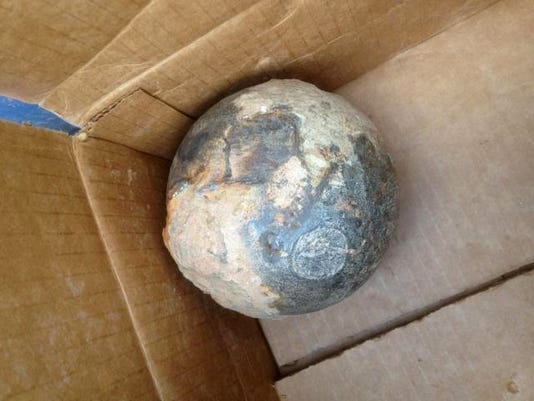
"The reason for it's [sic] being there remains a mystery," the paper says in the three-sentence summary it runs next to the seven-sentence story, for those too busy to plow through the whole thing. The article itself offers that "there are at least two possible scenarios for how it got there."
It then goes on to cite an Atlanta historian--who, to be fair, undoubtedly had plenty of interesting things to say that weren't included in the article--as to what those scenarios are.
One is that it's from the Union Army.
The other is that it's from the Confederate Army.
Saturday, July 13, 2013
Hey, there's a sort of national Civil War project!
I wrote back in 2011 about the possibility that the nation's theatre companies might outshine the federal government in observing the sesquicentennial; here's evidence that's happening: Four regional theatres and a performing arts center have announced partnerships with four universities to commission, develop, and premiere several new pieces of professional theatre relating to the war, along with presenting student work and academic symposia and the like. The umbrella organization calls itself the National Civil War Project.
"The American Civil War is arguably one of the most significant times in American history, an era that raised issues still relevant today," the press release's lead paragraph says in a sentence that does nothing but demonstrate how useless the word "arguably" is. (Is there really an argument to be made that the Civil War is not one of the most significant times in American history? Could we hear that argument, please?) The institutions involved are located in a few cities not all that far apart from each other, all on or near the Atlantic: Cambridge, Atlanta, Baltimore, Washington, and a Maryland suburb of Washington called College Park. "These diverse localities symbolize the geographic scope of the American Civil War," the press release tells us with a straight face. I guess "symbolize" can mean whatever it wants in this context, but in truth the geographic scope of the war comprised fighting in twenty-three states and six territories, plus naval battles. The final shot of the war was fired by a Confederate warship disrupting Union trade off the coast of Alaska; the final land battle was in Texas. No battles occurred in Massachusetts, however, so I suppose Cambridge symbolizes the siege of Vicksburg or something.
All right, so the press release is badly written and the project itself is not really national; the Tri-State-and-Federal-District Civil War Project is still an ambitious undertaking that may well generate a bunch of good plays, and so more power to them. Here's how it's supposed to go:
The Alliance Theatre in Atlanta is working with Emory University to develop and produce a stage version of Native Guard, a Pulitzer Prize-winning book of poetry about the Louisiana Native Guards, a Union regiment made up of former slaves. The author is Natasha Trethewey, head of Emery's creative writing program, who also double-dips as Poet Laureate of both the United States and the State of Mississippi. She'll be working on the show with Alliance's artistic director, Susan V. Booth, who directed shows around Chicago for a number of years and does great work.
American Repertory Theater, housed at Harvard University, is collaborating with its landlord on a set of programs that include developing and producing three shows: The Boston Abolitionists, about the Anthony Burns trial, to be devised by an ensemble of students in A.R.T.'s training program; War Dept., a musical being written by composer Jim Bauer and visual artist Ruth Bauer that A.R.T. describes as a show "set in Ford’s Theater that explores the lives of friends and family who search for answers among the records of the Civil War dead and wounded;" and Memoranda During the War, an opera being composed by Matt Aucoin based on Walt Whitman's journals of his time as a volunteer nurse in military hospitals during the war.
There are few cities that have the rich and complicated Civil War history that Baltimore has, but Center Stage in Baltimore (whose website renders its name both as one word and as two--is this really a hard thing to get the board to vote on?), working with the Clarice Smith Performing Arts Center at the University of Maryland, says it's commissioning an as yet untitled work by "a leading British playwright" that will explore British and international perspectives on the war. Um, okay. They also promise "the regional premiere of a Civil War-themed work around which significant artistic and community engagement programming will take place;" that turns out to be Paula Vogel's lightweight holiday show A Civil War Christmas. Ah well, so much for seizing the opportunity at Center Stage.
Arena Stage in Washington, in collaboration with George Washington University, plans three shows. One is Healing Wars, a dance piece with narration conceived and to be choreographed by Liz Lerner, whose idea the whole Project is. It "explores the experiences of the healers tasked with treating the physical and psychic wounds of battle." Our War will be an anthology piece commissioned from 25 playwrights that promises to be about not just the war but its continuing legacy. As yet untitled is a new piece from serial one-man-show deviser Daniel Beaty, "portraying the depth and breadth of humanity involved in the American Civil War." I presume Beaty, who's apparently great at this kind of thing, will play them all.
Most of this seems like a healthy amount of interesting activity. Let's hope something comes of it.
All right, so the press release is badly written and the project itself is not really national; the Tri-State-and-Federal-District Civil War Project is still an ambitious undertaking that may well generate a bunch of good plays, and so more power to them. Here's how it's supposed to go:
The Alliance Theatre in Atlanta is working with Emory University to develop and produce a stage version of Native Guard, a Pulitzer Prize-winning book of poetry about the Louisiana Native Guards, a Union regiment made up of former slaves. The author is Natasha Trethewey, head of Emery's creative writing program, who also double-dips as Poet Laureate of both the United States and the State of Mississippi. She'll be working on the show with Alliance's artistic director, Susan V. Booth, who directed shows around Chicago for a number of years and does great work.
American Repertory Theater, housed at Harvard University, is collaborating with its landlord on a set of programs that include developing and producing three shows: The Boston Abolitionists, about the Anthony Burns trial, to be devised by an ensemble of students in A.R.T.'s training program; War Dept., a musical being written by composer Jim Bauer and visual artist Ruth Bauer that A.R.T. describes as a show "set in Ford’s Theater that explores the lives of friends and family who search for answers among the records of the Civil War dead and wounded;" and Memoranda During the War, an opera being composed by Matt Aucoin based on Walt Whitman's journals of his time as a volunteer nurse in military hospitals during the war.
There are few cities that have the rich and complicated Civil War history that Baltimore has, but Center Stage in Baltimore (whose website renders its name both as one word and as two--is this really a hard thing to get the board to vote on?), working with the Clarice Smith Performing Arts Center at the University of Maryland, says it's commissioning an as yet untitled work by "a leading British playwright" that will explore British and international perspectives on the war. Um, okay. They also promise "the regional premiere of a Civil War-themed work around which significant artistic and community engagement programming will take place;" that turns out to be Paula Vogel's lightweight holiday show A Civil War Christmas. Ah well, so much for seizing the opportunity at Center Stage.
Arena Stage in Washington, in collaboration with George Washington University, plans three shows. One is Healing Wars, a dance piece with narration conceived and to be choreographed by Liz Lerner, whose idea the whole Project is. It "explores the experiences of the healers tasked with treating the physical and psychic wounds of battle." Our War will be an anthology piece commissioned from 25 playwrights that promises to be about not just the war but its continuing legacy. As yet untitled is a new piece from serial one-man-show deviser Daniel Beaty, "portraying the depth and breadth of humanity involved in the American Civil War." I presume Beaty, who's apparently great at this kind of thing, will play them all.
Most of this seems like a healthy amount of interesting activity. Let's hope something comes of it.
Sunday, July 7, 2013
Civil War stamps for 1863--that is to say, 2013

 I've been absent from the blog for over six months, mostly due to a mild case of exhaustion--not fatigue or burnout, just an accumulated period of sleep deprivation. I'm all rested now, I've made some permanent changes to my schedule and one thing I missed blogging about back in May when it was news was the release of this year's Civil War stamps. Every year during the sesquicentennial the Postal Service issues two stamps, each commemorating a key military event from 150 years earlier. The 2013 stamps commemorate, inevitably, the siege of Vicksburg and the battle of Gettysburg, the twinned events that turned the course of the war toward Union victory during the first week of July 1863. The Vicksburg stamp is taken from a Currier and Ives print published while the seige was still ongoing; the Gettysburg stamp is from an 1887 painting of the battle done by our old friend Thure de Thurlstrup, whose painting of the battle of Antietam was the basis for one of last year's stamps and who also painted "Sheridan's Ride."
 The specific event portrayed by Currier and Ives was summed up in the caption they gave their engraving: "Admiral Porter's Fleet Running the Rebel Blockade of the Mississippi at Vicksburg, April 16, 1863." Here's the original, via the Naval Historical Center:

"At half past ten P.M. the boats left their moorings & steamed down the river, the Benton, Admiral Porter, taking the lead -- as they approached the point opposite the town, a terrible concentrated fire of the centre, upper and lower batteries, both water and bluff, was directed upon the channel, which here ran within one hundred yards of the shore. At the same moment innumerable floats of turpentine and other combustible materials were set ablaze. In the face of all this fire, the boats made their way with but little loss except the transport Henry Clay which was set on fire & sunk."Fun fact to know and tell: Admiral David Dixon Porter was the brother by adoption of Admiral David Farragut, whose capture of New Orleans was depicted on one of last year's stamps.
The Thurlstrup painting upon which the Gettysburg stamp is based depicts a moment of Pickett's Charge, perhaps the climax of the whole war. Specifically, it shows General Winfield Hancock overseeing the devastating Union defense against the charge. Thurlstrup had been commissioned to paint twelve Civil War battles by L. Prang and Company, the commercial printer who popularized the Christmas card. Prang paid for careful research, and preliminary sketches were vetted by survivors of each battle depicted.

Thurlstrup's (or perhaps Prang's) title for the painting was "Hancock at Gettysburg," though today it's more often called simply "Battle of Gettysburg." A further indication of how much Hancock's Civil War fame has faded is that the Library of Congress makes a rookie error in its listing for this painting:
Shows Major General George Hancock leading the attack popularly known as "Pickett's Charge.""George" is Pickett's first name, not Hancock's. And of course Hancock is not leading the charge, he's defending against it.
One other thing: I want to stress just how great this whole series of stamps is. Compare them with two other Gettysburg commemoratives.

 The one to the left was issued in 1963 as part of the Civil War Centennial. Nothing wrong with it, of course, but it doesn't even attempt the richness of historical detail or the sheer gorgeousness of the stamps we're getting now. It is, however, miles above the cheesiness of what they issued in 1995, shown on the right. This one purports also to show Pickett's Charge, but except for the stone wall it could almost be any generic Civil War battle. And, for crying out loud, Brenda Starr had better artwork.
 The art designer for the Civil War Sesquicentennial stamps is Phil Jordan, and if the budget sequester hasn't eliminated his contract, he should renegotiate for
 more money. I learn from the website for something called Knottywood Treasures that he was art director for Air and Space, the magazine of the Smithsonian Institute's Air and Space Museum, for fifteen years and has designed over 250 stamps for the USPS on a contract basis since 1991. He designs a lot of air-and-space-related stamps, commemorating things like the first moon landing and classic American aircraft. He also did the great Thornton Wilder stamp, which I'm inserting here because I find playwrights more interesting than airplanes.
Monday, December 31, 2012
Music for New Year's Eve: The Year of Jubilo
Tomorrow is the sesquicentennial of the most revolutionary New Year's Day in American history, the day the Emancipation Proclamation took effect. The Proclamation is to this day not universally well understood; the always excellent James McPherson explains the impact it had in 1863 as well as anyone can in this recent piece; he calls it "a bombshell on the American public."
The song "The Year of Jubilo" (also known as "Kingdom Coming," "Ole Massa's Run Away," and "Lincoln's Gunboats") was written in the months leading up to the great day, and imagines what did in fact go on to happen: as the Union Army advanced, slaveowners fled, leaving their now former slaves to claim their freedom.
It was written by Henry Clay Work, a self-taught musician who had grown up in a household used as a stop on the Underground Railroad, and who composed in his head without an instrument. His biggest hit was another Civil War song, "Marching through Georgia," but he had post-war hits as well. "My Grandfather's Clock," from 1876, was recorded several times throughout the 20th Century, and as recently as 2004 by BoyzIIMen. The Oxford English Dictionary cites the song's 19th-Century popularity via sheet music as the origin of the term "grandfather clock" to refer to a weight-and-pendulum clock in a tall case. His 1868 hit "The Ship that Never Returned" is not particularly remembered today, but its melody and basic theme were lifted in the early 20th Century for the greatest train song ever, "The Wreck of the Old 97."
The "Jubilo" recording I've posted above is by Chubby Parker, principally remembered today for having the version he recorded of "Froggie Went A-Courting" included on The Anthology of American Folk Music. Parker was a regular on the WLS National Barn Dance in the mid-'20s, and his popularity there gave him a recording career. He made about 50 records, mostly of songs from the previous century.
Monday, December 24, 2012
Music for Christmas
Longfellow's poem "Christmas Bells," written on Christmas Day 1863, has over the years been set to two different melodies as the Christmas carol known by its first line, "I heard the bells on Christmas Day." In the 1870s, a London composer and church organist named John Baptiste Calkin set it to a melody he had composed thirty years earlier; in the 1950s, Johnny Marks--an American Jewish songwriter who cranked out the Christmas hits "Rudolph the Red-Nosed Reindeer," "A Holly Jolly Christmas," and "Rockin' around the Christmas Tree"--composed the setting more frequently heard today.
Still, there are a number of lovely recordings of the Calkin version out there, including this nice one by Elvis Presley and The Jordanaires. What I've posted above, though, is the Marks version sung by the magnificent voice of Harry Belafonte.
All recorded versions I've heard omit the three verses of Longfellow's poem that tie it to the Civil War and thereby give it real depth. Here's the whole poem; it's verses 3, 4, and 5 that get skipped:
I heard the bells on Christmas DayTheir old, familiar carols play,and mild and sweetThe words repeatOf peace on earth, good-will to men!And thought how, as the day had come,The belfries of all ChristendomHad rolled alongThe unbroken songOf peace on earth, good-will to men!Till ringing, singing on its way,The world revolved from night to day,A voice, a chime,A chant sublimeOf peace on earth, good-will to men!Then from each black, accursed mouthThe cannon thundered in the South,And with the soundThe carols drownedOf peace on earth, good-will to men!It was as if an earthquake rentThe hearth-stones of a continent,And made forlornThe households bornOf peace on earth, good-will to men!And in despair I bowed my head;"There is no peace on earth," I said;"For hate is strong,And mocks the songOf peace on earth, good-will to men!"Then pealed the bells more loud and deep:"God is not dead, nor doth He sleep;The Wrong shall fail,The Right prevail,With peace on earth, good-will to men.
Subscribe to:
Posts (Atom)